ICC hosts An Exclusive Session with Hon’ble Former Chief Justice of India, BR Gavai on ‘Indian Legal System: Investors’ Confidence & EoDB’
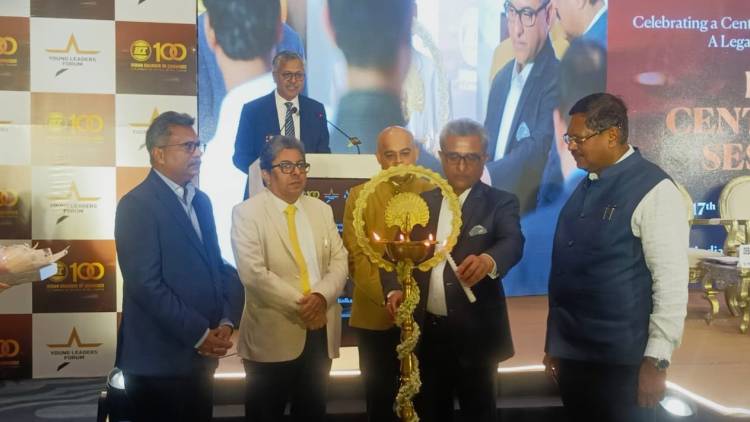
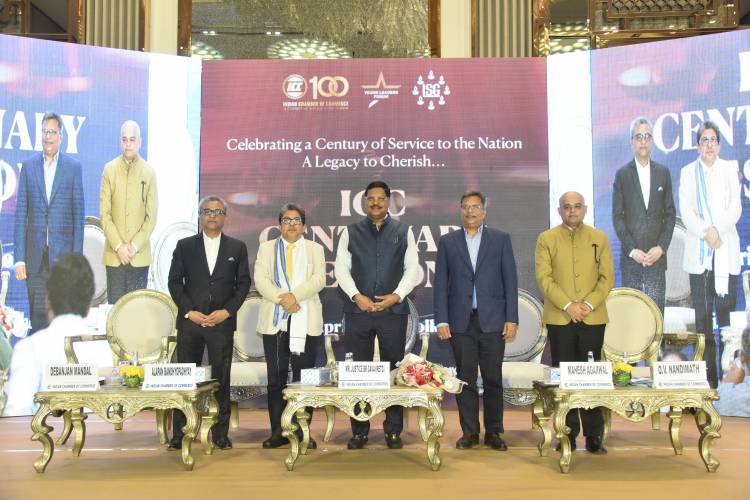
The Indian Chamber of Commerce (ICC) hosted an exclusive session with Hon’ble Mr. Justice B.R. Gavai (Retd.), Former Chief Justice of India, on the theme “Indian Legal System: Investors’ Confidence & Ease of Doing Business (EoDB)” bringing under one roof eminent legal experts, policymakers, and industry leaders, such as, Mr. Debanjan Mandal Managing Partner, Fox & Mandal Chair- ICC National Committee, Legal and Corporate Affairs Mr. Mahesh Agarwal Managing Partner Agarwal Law Associates, Mr. Alapan Bandhyopadhyay, IAS(Retd.), Prof. (Dr.) O.V. Nandimath, Vice Chancellor, West Bengal National University of Juridical Sciences and Dr. Rajeev Singh, Indian Chamber of Commerce, who deliberated on the evolving legal landscape in India and its critical role in strengthening investor confidence and facilitating a business-friendly environment.
Debanjan Mandal, Managing Partner, Fox & Mandal, Chair- ICC National Committee, Legal and Corporate Affairs welcomed the audience and the distinguished panelists and dignitaries and further added, “This event is designed to peel off some of the layers behi nd these generic terms and help us appreciate the underlying nuances and practical ramifications of the changes that have happened and what more needs to be done going forward. For context, ease of doing business is not a single overarching reform, law update or policy decision. It is the outcome of a gradual alignment between institutions, regulations and market expectations. And perhaps more importantly, it is shaped not just by what is written in the statute, but how that framework is experienced in practice — in the speed of decision-making, the predictability of contract enforcement, the consistency of regulatory interpretation, and the ability to plan confidently for the long term. These daily interactions build or indeed erode investor confidence as certainty is essential in business. If one looks at the global context, ease of doing business is a comparative concept. Jurisdictions compete on opportunity, certainty, clarity and the ability to minimize friction. The focus has shifted from simply easing into a new market to ensuring continuity, scalability and reliability throughout the business life cycle. The Indian experience reflects this evolution in a very real way. Discussions such as the one we're having today are particularly relevant for answering the burning question: what can we do to make these reforms and initiatives work for us and our businesses? What needs to happen so that implementation bottlenecks are well and truly addressed? What should change so that themes like EODB and investor confidence do not just remain abstract notions?”
Alapan Bandyopadhyay, Chief Advisor to Hon'ble Chief Minister of West Bengal & Chairman, Industrial Development Corporation quoted, “The phrase EODB has been in public domain for about two decades now. Popularized by the World Bank originally, it is a credo to make businesses easy and hassle-free. Many find this EODB, the way we practice it in India today, a bit narrowly framed. We probably should go much deeper into the realms of history, philosophy, ethics, and culture, as they call it these days, economic theology, to examine the underlying concept of reciprocal trust between the state and the businesses. The World Bank-driven indices and ranking methodologies to measure EODB are often simplistic, and the competition obsession generated by it can be counterproductive and misleading. Many have started suggesting now that businesses should be made easy, but not through abdication by
state of all responsibilities, but by laying transparent and easy ground rules governed by mutual trust and give and take. Social contracts should be robust in order to sustain viable business contracts. Ease of business should be integrated with equally serious emphasis on corporate social responsibilities and maybe, unpopular topic, progressive taxation. Unless both sides are seen, emphasis on only one side may not be socially sustainable. Business must be easy and creative, but the common good must also be remembered. Reciprocal trust and ease are of paramount importance. In the third wave of globalization now, India needs to evolve its own value regime to integrate ease of business with the values of equality and compassion. Ancient India's Karuna and Maitri now must be reconciled with World Bank's ease of doing business. Our EODB norms in our new era should be evolved in our own long and deep perspective.”
Speaking on the occasion, Mahesh Agarwal, Managing Partner Agarwal Law Associates, said, “Doing business, what is it? It is simply about procedures, how quickly you can set up the business, how you can get approvals, regulations and important things. India has made remarkable steps in the last 10 to 15 years on ease of doing business. But I want to talk about something slightly different and an extension of ease of doing business, which is ease of mind while doing business. Today, everybody is able to do business, but there is a lot of tension, there is no peace of mind. So, what should we do to promote ease of doing business while having peace of mind, which is most critical? Ultimately, why do you do business? For growth, for reputation, for a business leadership in the industry, but more importantly, peace of mind. That is very critical. So what is critical today is after you set up the business, certainty of laws. These are important things which shake the confidence of the industry and shake a person's peace of mind. Second is dignity. Every businessman who is putting in investment, getting bank funding, the least he needs is dignity. Third, I would say speed. It is not just justice delayed is justice denied. It is justice delayed is business destroyed. A strong and efficient, credible judiciary is not just a pillar of democracy, it is the backbone of economic confidence. So I would say to conclude that ease of doing business may attract investment, but ease of mind sustains it.”
O.V. Nandimath, Vice Chancellor West Bengal National University of Judicial Sciences said, “The aspect that I have been asked to speak in about ten minutes is the legal aspects of EODB. It is almost like I have been asked to talk about doing business or ea se of doing business in just a span of ten minutes, which is probably a Herculean task, but I have only three points because to my ease, my previous speakers have already, you know, touched upon nearly eight of my points, which I had for you.
The first one is we always say the core value of any initiative should stay intact, whereas the peripheral approaches of doing that can always change and must change and must be dynamic. So, what is a core value here we are talking is facilitating business to operate. When we drafted our constitution, which is the fundamental policy document of India, we included Article nineteen one G, where we ensured to everyone the freedom of trade and profession. I would rather say that is the core value. Everything of that according to me is procedural articulation of our core, you know, policy dedication, that it is your fundamental freedom to carry on trade and profession. I am of the opinion what ultimately business community is looking for three things. One is certainty and consistency. Second one, which was sort, you know, talked is speedier dispute resolutions. And the third and the last one is sustainability of all these efforts. That means we have laws. Of course, we in India, we have laws which are
comparable or matchable to any other country. But how these laws get translated into action, that is where the real problems come. A competency and capacity enhancement is the only way.”
Speaking on this occasion, Justice BR Gavai, said, “Let me say that any conversation on economic growth must begin with an emphasis on the legal system it underpins it. This is because markets do not function in a vacuum. They rely on a framework of trust in institutions, in processes, and above all, the rule of law. The rule of law is the foundation upon which the businesses are able to flourish. It provides assurance that rights will be protected, contracts will be enforced, and decisions will be governed by known and predictable principles rather than discretions or arbitrariness. This stability is essential for enterprise because economic activity depends at its core on the ability to plan, invest, and take risks when with a reasonable degree of certainty. India’s constitutional framework provides a strong foundation for such trust. The Constitution is not merely a political document; it is an economic document also. By guaranteeing rights such as equality before law, protection of life and personal liberty, and freedom to carry on trade and business, it creates the conditions necessary for economic participation and enterprise. However, I again emphasize that investor confidence is not built only on the text of the law, but on its consistent and predictable application. Certainty in legal outcomes, clarity in regulatory frameworks, and timeliness in dispute resolution are critical. A responsive and efficient judiciary can significantly enhance investor confidence, while delays and uncertainty can have the opposite effect. But the challenges facing us have remained. Backlog, delays in adjudication, and at times, divergent approaches to legal interpretation can dilute the overall efficacy and predictability of the system. In recent years, there has also been a growing emphasis on digitalization and technological integration within the legal system. E-courts, virtual hearings, and digital filing systems have improved efficiency and access. Let me conclude by saying this: the ease of doing business is not merely a policy objective. It is a constitutional aspiration. It requires us to align our economic goals with our constitutional values. If you are able to do that, and if you are able to build a system that is efficient, just, fair, then we'll not only attract investment, but also ensure that such investment contributes to the larger project of nation building.”
Finally, the session was concluded by Dr. Rajeev Singh, Director General, Indian Chamber of Commerce where he said, “It’s a very pleasant task for me to thank our esteemed chief guest. Truly an honour and as expected extremely engaging and full of knowledge and insights. For taking up so many questions with a lot of patience and a smile on his face. I would also like to thank Sri Alapan Bandyopadhyay, so eloquent and knowledgeable. He took us through the historical pages of ease of doing business, and his take of adding karuna to the ease and for the larger good of the society. We are also thankful to Professor Dr. O.V. Nandimath for bringing in his point of view what the law can do to make things easier for the businesses. And I personally liked one thing which he said, that what businesses want is dignity. Justice Gavai also mentioned that wherever wealth creation happens, I think the people around, the society around also benefits. But the system has to be trust-based. And what businesses truly need is certainty, timeliness, and a very trust-based and transparent system.”